Designing in Three Dimensions: Why 2D UX/UI Professionals Are Hitting a Wall in the Spatial Computing Job Market
Designing in Three Dimensions: Why 2D UX/UI Designers Are Hitting a Wall in the Spatial Computing Job Market
For much of the past two decades, a skilled UX/UI designer could move fluidly between companies, industries, and product categories. The foundational principles — hierarchy, flow, accessibility, user-centered research — translated reliably from one screen-based context to the next. A designer who mastered mobile interfaces could pivot to enterprise dashboards. Someone fluent in e-commerce UX could shift into fintech without reinventing their entire professional identity.
That portability is now running into a hard boundary. As spatial computing moves from an experimental frontier into a legitimate commercial sector, employers building for augmented reality headsets, virtual reality platforms, and mixed reality enterprise tools are discovering that the vast majority of available design talent was trained for a world that no longer defines the cutting edge. The skills gap is real, it is widening, and it is beginning to shape compensation, hiring timelines, and career trajectories in ways that designers cannot afford to ignore.
What Spatial Computing Actually Demands
The distinction between 2D and spatial design is not simply a matter of adding a third axis to a familiar workflow. It represents a fundamentally different cognitive and technical framework.
In traditional screen-based design, the canvas has edges. The designer controls what the user sees by managing a bounded rectangle — whether that rectangle is a phone screen, a browser window, or a widescreen monitor. Depth is an illusion created through layering, shadow, and scale. The user's body is largely irrelevant to the experience.
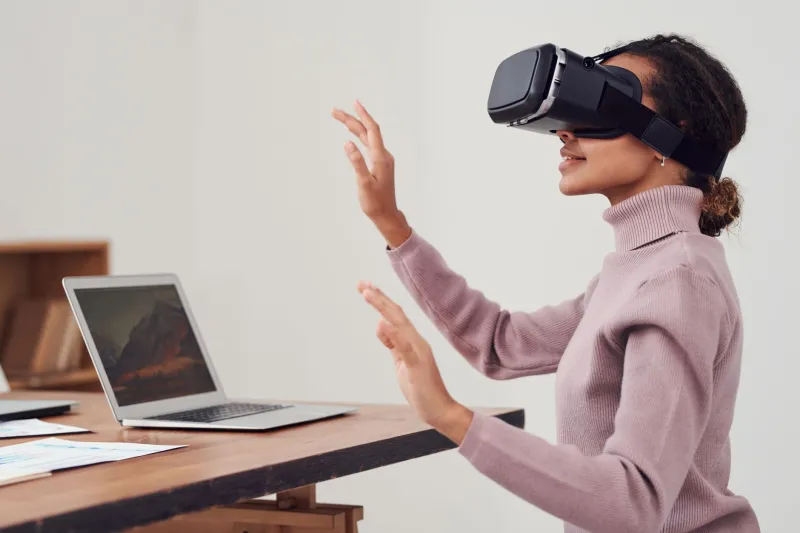
Spatial computing eliminates the rectangle entirely. In an XR environment, the user exists inside the interface. Content can appear at any point in a three-dimensional field of view, at varying distances, and in relation to real-world physical objects. The user's head position, hand gestures, gaze direction, and even their physical surroundings become active inputs that the design must account for in real time.
Hiring managers at spatial computing companies consistently identify several specific competencies that candidates from traditional design backgrounds lack:
Depth and scale calibration. Understanding how objects behave at different distances from a user's eyes — and how scale affects legibility, comfort, and perceived importance — requires spatial reasoning that flat-screen design simply does not develop.
Comfort zone and ergonomic awareness. Designers building for headsets must understand the physical strain of holding gaze on objects placed too close, too far, or at awkward vertical angles. This is a physiological discipline, not a visual one.
Interaction without a cursor. Gaze-based selection, hand tracking, voice commands, and controller input each demand entirely different interaction models. The hover state, the click, the scroll — none of these map cleanly into spatial contexts.
Environmental variability. Augmented reality experiences must function across radically different real-world settings — bright offices, dim warehouses, outdoor environments. Designing for that variability requires thinking that screen-based work never demands.
Real-time engine literacy. Many spatial experiences are built and tested inside game engines such as Unity or Unreal Engine. Designers who have never worked within these environments often find themselves unable to prototype, iterate, or communicate effectively with their engineering counterparts.
The Hiring Manager's Perspective
Leaders responsible for building design teams at spatial computing companies describe a consistent frustration: candidates arrive with impressive portfolios and genuine talent, but their work demonstrates no understanding of how users inhabit an environment rather than simply view it.
The filtering process has become costly. Companies report extending hiring timelines significantly because the pool of candidates who combine design sensibility with spatial fluency remains shallow relative to demand. Some organizations have begun hiring candidates with strong game design or architectural visualization backgrounds — disciplines that have always operated in three dimensions — and then layering on UX methodology. Others are investing in internal training programs to bridge the gap for promising 2D designers who demonstrate adaptability.
Both approaches carry real costs. Neither is a long-term substitute for a market that produces spatially fluent designers from the outset.
Where Traditional Design Skills Still Hold Value
It would be inaccurate — and counterproductive — to suggest that a background in conventional UX/UI design is a liability in the spatial computing sector. Several core competencies transfer directly and remain genuinely scarce even among candidates with spatial technical skills.
User research methodology, accessibility thinking, content hierarchy, and the discipline of testing assumptions against real user behavior are not rendered obsolete by a three-dimensional canvas. In fact, many spatial computing products suffer precisely because they were built by technically capable developers and engineers who lacked the user-centered rigor that trained UX professionals bring.
The opportunity, therefore, is not to abandon existing expertise but to extend it into new technical territory. Designers who can combine established UX discipline with spatial fluency represent an exceptionally valuable profile — and the market is currently paying accordingly.
A Practical Roadmap for the Pivot
For 2D designers who recognize the direction the market is moving, the path forward is demanding but navigable. The following sequence reflects the approach that hiring managers and career development specialists in this space most frequently recommend.
Develop spatial intuition before touching tools. Study architectural design, stage direction, and game level design — disciplines that have long grappled with how humans experience and navigate three-dimensional space. Understanding the principles conceptually accelerates the technical learning that follows.
Learn a real-time engine at a functional level. Unity offers a well-documented learning pathway and remains the most common platform for XR development in the US market. Designers do not need to become engineers, but they must be capable of building and testing their own prototypes within the engine environment.
Engage with XR hardware directly. Access to a Meta Quest headset, a HoloLens development kit, or comparable hardware is no longer optional for designers serious about this transition. There is no substitute for understanding how spatial interfaces actually feel from inside the experience.
Build a spatially specific portfolio. Hiring managers are explicit on this point: a portfolio composed entirely of app and web design work does not demonstrate spatial capability, regardless of its quality. Even prototype-level spatial projects signal that a candidate understands the domain.
Pursue targeted credentialing. Several US-based institutions and online platforms now offer coursework specifically in XR design and spatial UX. While credentials alone are rarely decisive, they provide structured learning and, more importantly, demonstrate intentional commitment to the transition.
The Window Is Still Open
The spatial computing sector is not yet mature enough to have closed the door on career changers. The talent pipeline remains underdeveloped, and companies are actively seeking designers willing to invest in the skills the market requires. That window will not remain open indefinitely. As university programs respond to employer demand and as a new generation of designers begins training with spatial tools from the outset, the advantage currently available to experienced 2D professionals who make the pivot early will diminish.
For designers who have built strong careers on screen-based work, the spatial computing skills gap is simultaneously a professional challenge and a genuine opportunity. The transition requires real effort and real investment. The designers who make it now, before the market fully matures, are positioning themselves at the front of a hiring wave that shows no signs of receding.